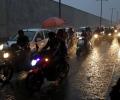
The June-September monsoon has so far delivered 1 per cent higher rainfall than average

The India Meteorological Department has issued a 'red' alert for Mumbai, Thane, and Raigad districts, forecasting heavy to very heavy rainfall and strong winds. Residents are advised to avoid unnecessary travel, and warnings include potential flash floods, structural damage, and disruptions to essential services. The Brihanmumbai Municipal Corporation has also urged caution and deployed officials to monitor the situation.

Rain and road trips go hand in hand in Maharashtra. For countless travellers, the season isn't complete without a plate of steaming-hot Kanda Bhaji on a jaunt to Karjat at Thakare Hotel.
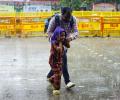
The record monsoon rains across India during the June to September months was 937.2 millimetres, the 5th-highest since 2001 and 38th-highest since 1901.

Thousands of protesters, including children, students, and the elderly, gathered in central Delhi for the Cockroach Janta Party's 'Chalo Sansad' march towards Parliament. The protest, coinciding with the Monsoon Session, led to clashes with police, who used tear gas and lathi-charge, resulting in injuries to both sides and suspension of internet services. Despite police action and barricades, protesters repeatedly attempted to reach Parliament, leading to a day-long standoff.

Several districts in Uttar Pradesh experienced rainfall, with Kanpur City recording the highest precipitation. The India Meteorological Department reported a drop in temperatures across the state, including Lucknow, and issued a forecast for continued rain in western UP.

The India Meteorological Department (IMD) has predicted below-normal rainfall for India during the second half of the southwest monsoon season, specifically from August to September. This forecast indicates less than 94 per cent of the Long Period Average (LPA) for the period. While July saw good rainfall activity due to low-pressure systems and the Madden-Julian Oscillation, the Southern Peninsula experienced significantly low rainfall and record high minimum temperatures.

India's consumption stocks, which have outperformed the broader market, are now facing significant pressure due to a gradual rise in fuel prices and the potential for higher inflation. Analysts warn that companies may be forced to pass on increased input costs to consumers, potentially hurting demand across both staples and discretionary categories, with a looming threat of deficient monsoon rainfall further exacerbating inflationary concerns.

The India Meteorological Department (IMD) has issued an orange alert for Mumbai, predicting heavy to very heavy rainfall, thunderstorms, lightning, and gusty winds for the next few days. The forecast extends through Friday, with a brief yellow alert on Tuesday. Neighbouring Palghar is under a red alert, and Raigad is under an orange alert for five days.

Bollywood superstar Salman Khan has initiated a multi-phase relief drive through his Being Human organisation and fan club in Assam, providing food, medicines, and essentials to families affected by devastating floods, with plans for long-term rehabilitation support.

ITC reported a 16.2 per cent year-on-year drop in consolidated net profit to 4,394.13 crore in Q1 FY27, primarily due to a significant increase in taxes on its cigarette business. Consolidated net revenues also declined by 11.1 per cent to 19,114 crore, missing analyst estimates.

The Bombay High Court strongly criticised the Brihanmumbai Municipal Corporation (BMC) for its failure to secure open manholes, questioning why it acts only after fatalities occur. The court dismissed BMC's progress reports as an "eyewash" following the death of Aslam Shaikh, who fell into an open manhole. Despite BMC's assurances and actions like suspending officials and offering compensation, the court emphasised the need for preventive measures before the monsoon season.

The monthly average rainfall over India is expected to be below normal during July, the India Meteorological Department said on Tuesday in its monthly forecast.

Cricketer-turned-politician Harbhajan Singh revealed in a podcast interview that his decision to switch from the Aam Aadmi Party (AAP) to the Bharatiya Janata Party (BJP) stemmed from the AAP government's alleged neglect of his concerns regarding drug abuse and sports promotion in Punjab.

The weather office has warned that the prevailing monsoon conditions could trigger flash floods, landslides, waterlogging and a further rise in river levels across the Northeast.

Sarfaraz Khan has been recalled to India's Test squad for the two-match away series against Sri Lanka, starting August 15, following an injury to Sai Sudharsan. This recall comes after two years of consistent performance and a significant physical transformation, including shedding 17kg.

During the four-month monsoon period, India recorded the highest rainfall since 1994, according to the India Meteorological Department.

'We should expect extreme heat, extreme rains, floods, landslides and maybe cyclones. Not just this year, in the coming year as well.'

Blue is one of those rare shades that can instantly define your mood and, quite ironically, even beat the blues for you.

After six days of stalemate, a discussion on the anti-paper leak bill began on Tuesday in Lok Sabha with the government describing it as a reaffirmation of ruling dispensation's commitment to safeguard the welfare of students but opposition hit back over the lathi-charge on protesters, saying every blow on them hurt the government's prestige more than the backs of the youth.

Activist Sonam Wangchuk has extended his indefinite hunger strike, stating he will continue until youth leaders meet parliamentarians or he is allowed to do so from the hospital. This decision follows police action against protesters during the Cockroach Janta Party's "Sansad Chalo" march, where thousands were detained while demanding accountability for alleged irregularities in competitive examinations and the resignation of Union Education Minister Dharmendra Pradhan.

A single night of deadly floods wiped out an entire village in Assam, leaving families without homes, cattle or hope.

Cyril Radcliffe drew India's border without ever visiting it. Turns out our environmental clearance system learned the same trick -- and the Western Ghats are paying for it, points out Binu Alex.

Following the tragic death of a student in Mumbai due to a tree collapse, Thane Mayor Sharmila Pimpalolkar has mandated a city-wide safety survey of dangerous trees. The survey will cover schools, colleges, housing societies, hospitals, and major traffic junctions, with a focus on identifying and addressing unstable trees and branches to prevent future incidents, especially during the monsoon season.

A committee investigating the fatal Chembur tree crash has recommended fines of Rs 5 lakh on the roadwork contractor and Rs 2 lakh on the supervising consultant. The panel found no prima facie fault with BMC's garden and roads departments but suggested implementing a Standard Operating Procedure for urban tree safety and appointing tree experts to oversee pruning work to prevent future incidents.

A 55-year-old man died after falling into an open manhole in Mumbai during heavy rains, leading to the Brihanmumbai Municipal Corporation (BMC) suspending four officials and initiating a homicide case against the responsible contractor for alleged negligence.

A baby Indian Rock Python was safely rescued from the locomotive cabin of the Madgaon-CSMT Janshatabdi Express upon its arrival at CSMT, Mumbai. The incident, occurring during the monsoon season, highlights wildlife seeking shelter and marks the second reptile rescue in the city recently.

The India Meteorological Department (IMD) has predicted above-normal rainfall for most parts of India during the post-monsoon season (October to December), except for some areas in the northwest. The southwest monsoon season ended with the country recording eight per cent above normal rainfall.

'It is not because of the war in West Asia, which began on February 28.' 'Petroleum product prices are already going through the roof. They are bound to have a serious inflationary impact.' 'A country's leadership is tested in trying times. It is here that the current leadership is failing.'

The water rose from knee level to chest height within minutes before climbing even higher. Homes crumbled, cattle sheds collapsed and everything that could be carried away by the current vanished.

The latest forecast, given by Earth Sciences Minister Jitendra Singh, was a downward revision from a previous forecast of 93 per cent given at the outset of the monsoon in June, but was nowhere near as bad some farmers had feared.
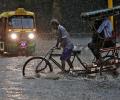
It's still early days, but the southwest monsoon has been nearly 37 per cent 'below normal' in the first seven days (June 1-7) of this month. According to the data furnished by the India Meteorological Department (IMD), between June 1 and June 7, India received 14.5 millimetres (mm) of rainfall, against a 'normal' 23.1 mm. Among places where rains have arrived, monsoon in Kerala in the first seven days has been 48 per cent 'below normal', while in Puducherry, it has been 56 per cent 'above normal'. In Tamil Nadu, rains were 21 per cent 'above normal' between June 1 and June 7.

'Those under pressure from the BJP and the police, or due to court cases, the ED, CBI, CID, local police officers, or the STF, I request that you make your decision before July 21.'
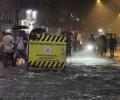
The southwest monsoon arrived in Maharashtra on Sunday, making it the earliest onset of the annual rainfall season over the state in 35 years, according to the India Meteorological Department. The monsoon is expected to advance to Mumbai and some other parts over the next three days. The monsoon advanced into some more parts of the Arabian Sea, Karnataka, entire Goa, parts of Maharashtra, north Bay of Bengal, and parts of Mizoram, parts of Manipur and Nagaland on Sunday. The northern limit of monsoon passes through Devgad, Belagavi, Haveri, Mandya, Dharmapuri, Chennai, Aizawl and Kohima. Conditions are favorable for further advance into some more parts of central Arabian Sea, more parts of Maharashtra including Mumbai, Karnataka including Bengaluru, some parts of Andhra Pradesh, remaining parts of Tamil Nadu, more parts of west-central and North Bay of Bengal and some more parts of North Eastern states during next three days. The southwest monsoon hit Kerala on Saturday, marking its earliest arrival over the Indian mainland since 2009.

Normally, the southwest monsoon makes its onset over Kerala by June 1 and covers the entire country by July 8. It starts retreating from northwest India around September 17 and withdraws completely by October 15.

India's total automobile retail sales recorded a significant 9.55 per cent year-on-year growth in May, reaching an all-time high of 25,31,067 units, driven by strong performances in three-wheelers, passenger vehicles, and tractors, despite prevailing heatwave conditions and fuel price pressures.

Delhi Chief Minister Rekha Gupta has directed officials to ensure the transparent and timely implementation of welfare schemes announced in the budget, warning of potential fund reductions for departments failing to utilise allocated budgets effectively.

'Why not aspire for 8 or 9 or even 10 per cent?'

The Brihanmumbai Municipal Corporation (BMC) has announced a 10 per cent water cut across Mumbai starting May 15, citing concerns over a below-normal monsoon forecast due to the El Nino weather pattern. The current water stock in the city's seven lakes is expected to last until July 6.

Now, the recent heavy rain has sparked panic among the disaster-hit families of Joshimath.
